What the ideal facility intelligence platform looks like (2026)
 Milvian AI teamFacilities and infrastructure intelligence

The ideal facility intelligence platform is one data layer for every site, system and sensor, with water, energy and air read together. It shows live digital twins of the real systems, baselines use against weather so savings are real, explains findings in plain language, routes work to the CMMS,, and acts on equipment only where control is enabled, with owner approval, with every command audited.
Why facilities need more than a BMS and a dashboard
Most facility teams already have plenty of systems. A BMS runs the air handlers. A CMMS holds the work orders. Meters report to a utility portal. An air quality pilot lives on a vendor dashboard. Bills arrive monthly. Each tool does its job, and none of them answers the question leadership actually asks: where are we losing money and resources, and what are we doing about it?
That question crosses every boundary. A leak in a cooling tower shows up as water, energy and chemical cost. Poor ventilation in a crowded room is an air quality problem with an energy fix. A tariff penalty is an electrical problem with an operations cause. A platform that sees only one of these will always miss part of the answer.
Facility intelligence is the category that tries to answer the whole question. It starts with awareness, because most teams genuinely do not know what is happening inside their buildings, then adds optimization and control on top of that awareness. The ideal version behaves like a command and control center for a facility.
It also has to serve more than one audience. The technician needs to know which valve is passing. The facility manager needs to know which site needs attention this week. Finance needs savings in money it recognizes, verified rather than estimated. Sustainability needs figures that trace to a meter. Leadership needs the portfolio picture. One data layer can serve all of them, as long as each view is built for the person using it.
What the ideal facility intelligence platform must do
| Requirement | Why it matters | Question to ask a vendor |
|---|---|---|
| One data layer for everything | Water, energy and air problems overlap | Do all modules read from the same store and hierarchy? |
| A clear site hierarchy | Every reading needs a place | Can I see site, floor, zone and device for every reading? |
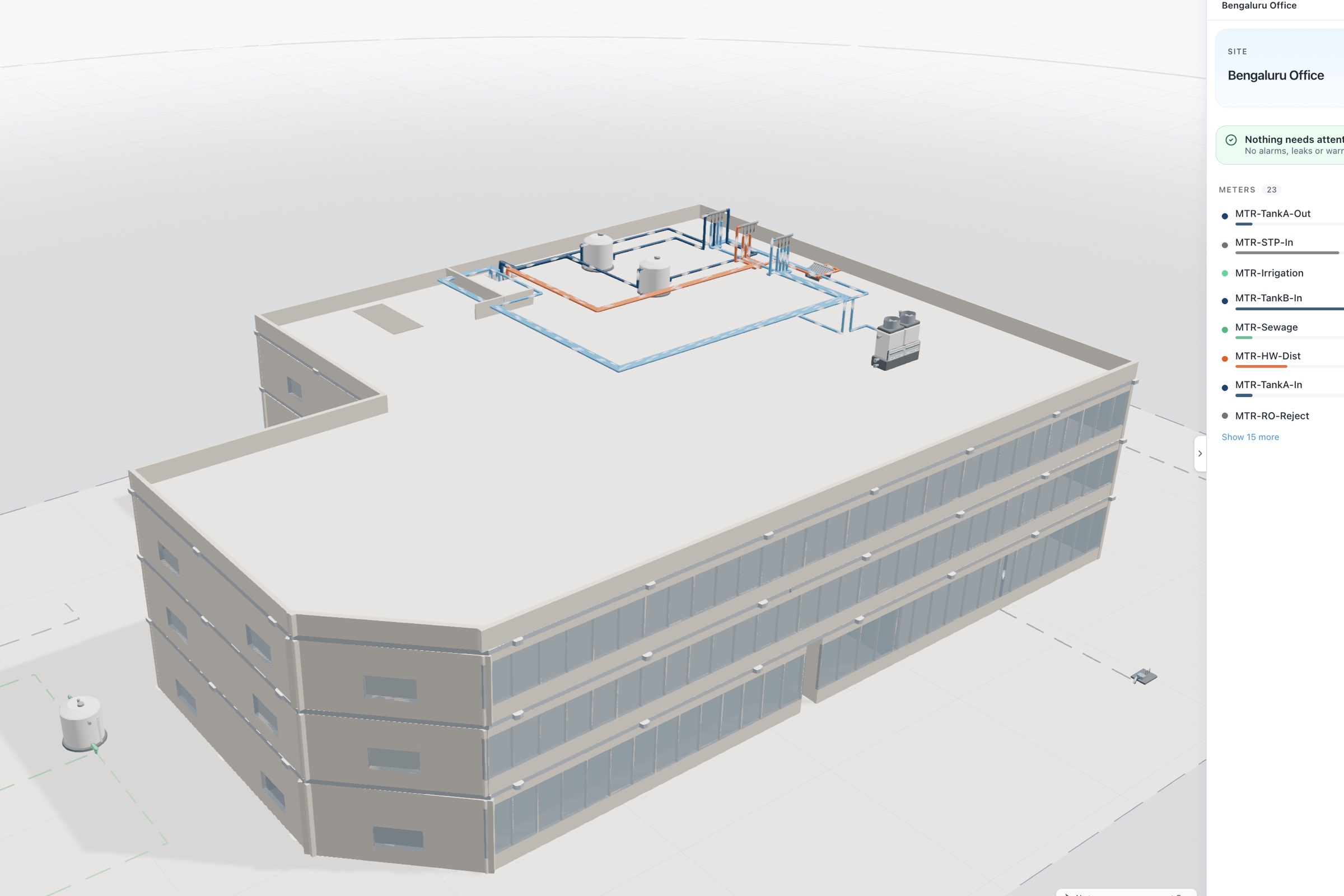
| Live digital twins | A twin of the real system shows where loss happens | Is the twin built block by block to match our installation? |
| Balance equations | Unaccounted water or energy is the waste signal | Do you show water and energy balances with the loss term live? |
| Weather-normalized baselines | Without them, savings are guesses | Do you use degree days, and can bills give a day-one baseline? |
| Plain-language findings | Teams act on reasons, not colors | Does each finding come with the standard, cause and action? |
| Data you can trust | Bad data destroys confidence | Is sensor health visible per device? |
| Real, audited control | Insight without action changes nothing | How do you control equipment, and is every command logged? |
| Open integration | Nobody replaces everything | Which protocols and systems can you read and write? |
The categories buyers compare
- Traditional BMS and BASProven control of HVAC with local sequences. Usually one building, one vendor, limited water and portfolio view.
- EMS dashboardsGood energy charts. Usually energy only, display only.
- IoT monitoring platformsFast wireless sensing. Often stop at the chart.
- CMMS and EAMAssets and work orders. Depend on others to detect problems.
- Bill services and consultantsMonthly data and expert judgment. Late and periodic.
- Facility intelligence platformsOne layer across systems, with twins, baselines, findings and control. They work with the others rather than replacing them.
How to evaluate a facility intelligence platform
- Start with the questionWhere are we losing money and resources? List the systems and sites where you suspect the answer lies.
- Load bills for a day-one viewSix to twelve months of bills should give weather-normalized baselines immediately.
- Survey and plan instrumentationWalk the sites, list existing meters and controllers, and plan sub-metering and sensors.
- Pilot with a full loopChoose a site where you can go from awareness to diagnosis to action, with control only where control is enabled, with owner approval.
- Measure the resultSavings against baseline, faults found and closed, and commands audited.
Facility intelligence scorecard
| Criterion | Weight | What good looks like |
|---|---|---|
| Unified data layer | 15% | Water, energy and air in one hierarchy |
| Digital twins and balances | 15% | Twins of the real systems with live balance equations |
| Baselines and money | 15% | Weather-normalized, priced through rate configuration |
| Findings and AI | 15% | Plain-language findings and an assistant that answers questions with evidence |
| Data trust | 10% | Sensor health and data quality visible |
| Control and audit | 15% | Relays and field devices, occupancy-driven rules, command history |
| Integration and ways in | 15% | Keep, replace or build, with open protocols |
Integration and data
The ideal platform reads what is already there. Existing BMS over BACnet and Modbus, utility meters, SCADA read only where relevant. It adds wireless LoRaWAN sensors and meters where coverage is thin, and anything that emits telemetry can be onboarded, including vibration and acoustic sensors for rotating equipment.
Control has two practical paths: LoRaWAN relay switches for simple loads such as exhaust fans and lights, and field device controllers that speak Modbus or BACnet for complex equipment such as air handlers, rooftop units, chiller plants and VAV boxes. Devices can be grouped so sensors inform equipment and the group is analyzed as one system. Every command is recorded, and lockouts stop new commands while earlier ones are still being acted on.
Outputs go where work happens: the CMMS for faults, finance for savings, sustainability for reporting, and tenants for their share of shared meters.
Compliance and reporting
- Energy standardsISO 50001 and ASHRAE 90.1 style performance, measured and normalized.
- Air standardsASHRAE 62.1 and WELL style indoor air requirements, monitored in use.
- Water auditsBalances that close, in the style of AWWA M36.
- Disclosure and performance lawsGRESB, CSRD and building performance standards fed from meters.
Where Aqueduct fits
Aqueduct was built to this shape. aQ Core is the brain and spine: sites, floors, zones and devices, ingest and storage, with sensor health on every device and aQ Assistant answering questions about any site in plain language. aQ WaterGuard, aQ EnergySmart and aQ AirSafe each follow the same path from site map to portfolio to digital twin to analytics. The twins show the water balance equation, the electrical single line and the component states of individual rooftop units.
Baselines use regression on usage plus cooling and heating degree days, and uploading bills gives results on day one; rate configuration turns the difference into money. Where control is enabled, with owner approval, Smart Controls acts through LoRaWAN relays or Modbus and BACnet field devices, with occupancy-driven automations and a full command history. Aqueduct runs across 275+ sites in 21 countries, and organizations can keep, replace or build their systems around it.