BMS vs BEMS vs EMS: what is the difference and which do you need
 Milvian AI teamFacilities and infrastructure intelligence
A BMS controls building equipment such as air handlers, chillers and lighting. A BEMS is a BMS with energy metering and reporting added. An EMS measures and manages energy use, often across sites, but may not control anything. Most owners need control, measurement and verification together, across energy, water and air, which is the gap a facility intelligence platform fills.
Three acronyms, one confused buying conversation
Ask five vendors what a BMS, a BEMS and an EMS are and you will get five answers, each drawn to put their own product in the most flattering box. Facility teams then end up comparing a controls system with a reporting tool with a metering service, and wondering why the proposals look nothing alike.
The confusion has a history. The building management system grew out of HVAC controls: it was there to run sequences, hold setpoints and raise alarms. Energy reporting was bolted on later, which produced the building energy management system. Separately, energy management systems grew up in the utility and industrial world, focused on meters, tariffs and consumption rather than on controlling a chiller.
The useful question is not which acronym is best. It is which jobs your buildings need done: control, measurement, diagnosis, verification and reporting, for which utilities, across how many sites. Once you list the jobs, the right category is usually obvious.
BMS, BEMS and EMS side by side
| Question | BMS or BAS | BEMS | EMS |
|---|---|---|---|
| Primary job | Control HVAC and other building systems | Control plus energy monitoring | Measure and manage energy use and cost |
| Typical data | Control points, setpoints, alarms | Control points plus some energy meters | Utility meters, sub-meters, bills, tariffs |
| Controls equipment | Yes, that is its purpose | Yes | Usually no, or only through another system |
| Covers water and air quality | Rarely water, air only where wired | Rarely | Usually energy only |
| Multi-site view | Each site usually separate | Limited | Often strong |
| Weather-normalized baselines | No | Sometimes basic | Sometimes |
| Fault diagnosis | Alarms, not diagnosis | Limited | Rarely |
| Verifies savings | No | Partly | Partly, often from bills |
What each one does well, and where it stops
A BMS is excellent at what it was built for. It runs time schedules, holds space temperatures, sequences chillers and boilers and raises alarms when a value leaves its band. It is local, fast and trusted by engineers. It stops at the boundary of control: it knows what it told a valve to do, not what the plant consumed, and it rarely keeps more than a few weeks of trend data.
A BEMS extends the BMS with energy meters and reports. That is a real step forward, because it connects control actions to consumption. It usually remains a single-site tool, built by the same manufacturer, and it seldom covers water or air quality in any depth.
An EMS starts from the other end. It collects meter and bill data, often across a whole portfolio, and is good at showing where the money goes and which sites spend the most. Many EMS products cannot see inside the building at system level and cannot act on what they find, so the findings go into a report and wait for someone to do something about them.
Each tool is the right answer for a narrow job. The trouble is that most owners do not have a narrow job.
How to decide which you need
- List the decisions you want to makeFor example: which sites waste the most, which chiller is drifting, where the water goes at night, whether last year's retrofit worked. Write them down before any vendor meeting.
- Map each decision to a jobControl, measurement, diagnosis, verification or reporting. Most lists need all five.
- Check what you already ownIf you have a working BMS, you already have control. The gap is usually measurement, diagnosis and verification across sites.
- Check which utilities matterIf water, steam or air quality are on your list, an energy-only tool will leave part of the job undone.
- Choose the category that closes the gapKeep what works, and add the layer that answers the remaining questions rather than buying a second system that does the same job as the first.
A simple decision scorecard
| Your situation | Weight in the decision | What usually fits |
|---|---|---|
| New building, no controls yet | High | A BMS for control, with metering and an intelligence layer designed in from the start |
| Working BMS, no idea what each system costs | High | Keep the BMS and add system level metering, baselines and diagnosis on top |
| Many sites, only bills today | High | Portfolio baselining from bills first, then metering on the sites that stand out |
| Controllers end of life | Medium | Replace control and measurement together so the new system is measured from day one |
| Water or air quality matter as much as energy | Medium | A platform that covers all three utilities in one data layer |
| Savings must be proven to finance | Medium | Weather-normalized baselines and verification at the meter |
Integration and data
None of these systems should live alone. A BMS speaks BACnet or Modbus, sometimes through a proprietary gateway. Meters may be pulse, Modbus or wireless. Many newer sensors use LoRaWAN, which is well suited to occupied buildings because it needs no new cabling. Water treatment and process plants often run SCADA, and the maintenance team runs a CMMS.
The practical architecture is one data layer that reads all of these sources, models the building on top of them, and writes findings back into the tools people already use. That way the BMS keeps doing control, the CMMS keeps handling work orders, and the new layer does the measurement, diagnosis and verification none of them were built for.
Compliance and reporting
ISO 50001 asks for an energy management system in the management sense: a policy, an energy review, baselines, performance indicators and continual improvement. That is a process, not a product, but it needs data that a BMS alone rarely provides. Benchmarking in ENERGY STAR Portfolio Manager, building performance standards and investor frameworks such as GRESB all ask for consistent, auditable consumption figures.
Whichever acronym you buy, check that it can produce those figures per site and per period, with gaps flagged rather than hidden. The software supplies the evidence. The owner, the auditor or the authority decides the rest.
Where Aqueduct fits
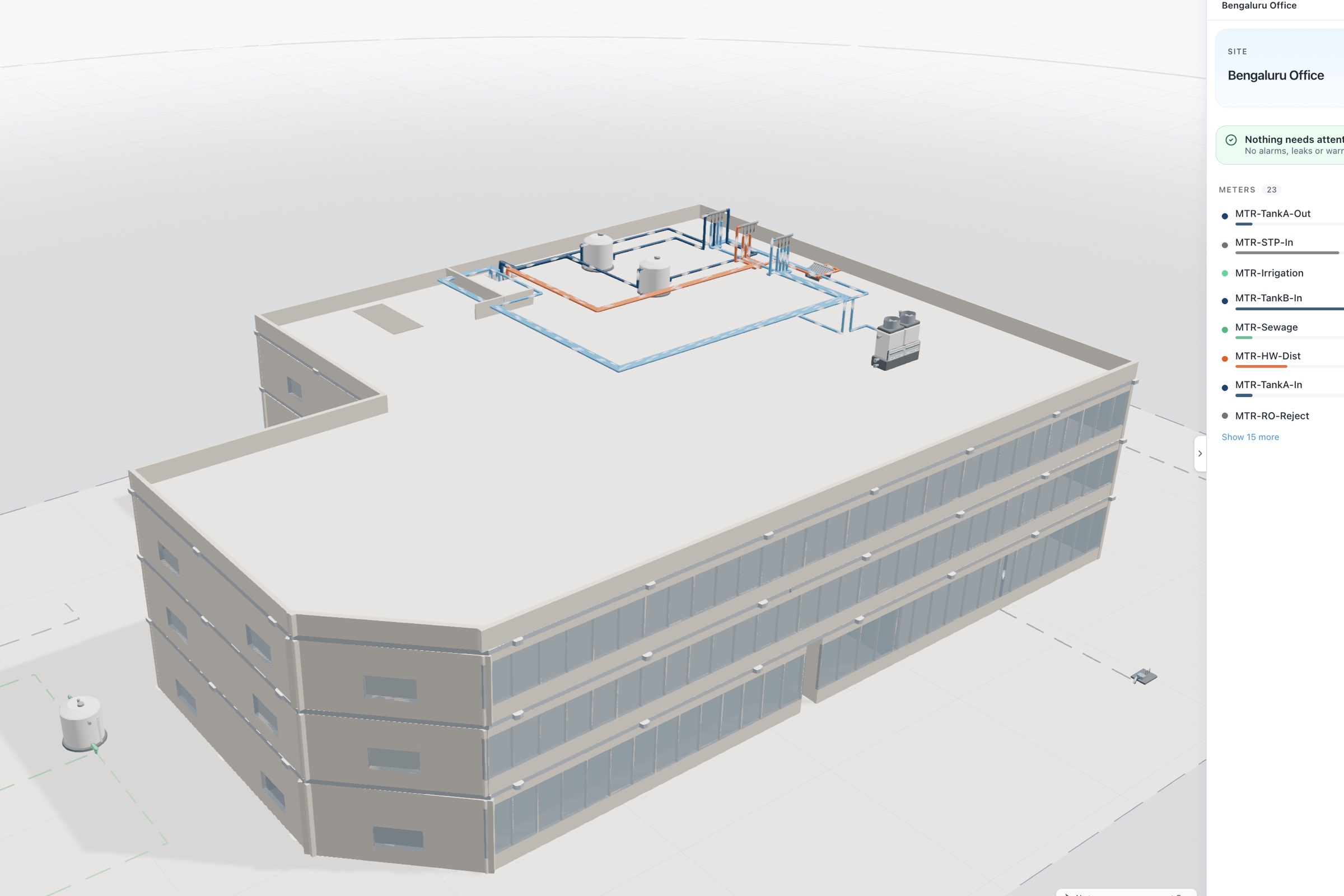
Aqueduct is not a BMS, a BEMS or an EMS in the narrow sense. It is a facility intelligence platform that does the jobs all three share and the ones they leave out. aQ Core holds sites, floors, zones and devices in one model. aQ EnergySmart covers electricity and gas with an electrical digital twin and weather-normalized baselines, aQ WaterGuard covers water with a live water balance, and aQ AirSafe covers air quality with occupancy overlaid.
Smart Controls acts on equipment through LoRaWAN relay switches or Modbus and BACnet field devices, where control is enabled, with owner approval, and logs every command. If you already have a BMS, Aqueduct reads it. If it is at end of life, Aqueduct can replace it. If you are building new, it can be designed in.