What is EHS software, and where does facility data fit?
 Milvian AI teamFacilities and infrastructure intelligence
EHS software is the system an organization uses to manage environment, health and safety work: incidents, risk assessments, permits, audits, training, chemicals, corrective actions and regulatory reporting. It manages workflows and records. Facility data, meaning continuous measurement of air, water, effluent and energy, sits beside it as the evidence layer those workflows depend on. The two complement each other.
What EHS software is
EHS stands for environment, health and safety. EHS software is the system of record for that work. It replaced the binders, registers and spreadsheets that EHS teams used to run, and most suites are built as modules an organization switches on as it needs them.
The core is workflow. Someone reports an incident, it is investigated, a root cause is recorded, corrective actions are assigned and closed. A permit to work is requested, approved and closed out. An audit is scheduled, carried out against a checklist and its findings tracked. Training is assigned and its completion recorded. Chemicals are registered with their safety data sheets. Regulatory returns are prepared and filed. Good EHS software makes all of this visible, traceable and auditable.
What EHS software does not usually do is measure the physical world. Its environmental figures, such as discharge volumes, emissions, water use and workplace air readings, come from somewhere else: lab reports, logbooks, bills, other systems or people typing in readings. That is where facility data comes in.
The people who use EHS software are the EHS manager and team, site leaders who approve permits and actions, supervisors who report incidents, and auditors who review the record. Most of them never look at a meter or a sensor. They need the measured facts to arrive in a form that answers their question: what happened, where, for how long, and did the fix work.
What an EHS program needs, and where the data comes from
| EHS need | Why it matters | Question to ask about the data |
|---|---|---|
| Incident and near miss records | The core of a safety program | When an environmental incident is logged, is there a measured record of what happened? |
| Environmental aspects register | ISO 14001 asks for significant aspects to be monitored | Which aspects are measured continuously, and which by sample? |
| Discharge and emissions returns | Regulators set conditions on volume and quality | Do the figures trace to a meter or to an estimate? |
| Workplace air and exposure | Workers need protection from dust, fumes and poor ventilation | Do you know what happens between statutory surveys? |
| Water management | Abstraction, reuse and Legionella control all need data | Does the site water balance close? |
| Energy and emissions reporting | Scope 1 and 2 and energy standards need metered data | Is energy baselined against weather and production? |
| Audit evidence | Auditors ask for records for a defined period | Can you produce a period record with data quality shown? |
| Corrective action verification | A closed action should show the problem stopped | Can the measurement confirm the fix worked? |
The tools in the EHS data stack, and what each does well
- EHS management suitesIncidents, permits, audits, training, chemicals, actions and returns. The system of record for the EHS program and the people in it.
- Lab and sampling servicesThe reference for regulated parameters, accredited and defensible. Periodic by nature.
- BMS, SCADA and historiansRun equipment and store tags. Rich in data, but built for control engineers rather than evidence.
- Single-parameter sensor dashboardsFast to deploy for air or one meter. Often isolated, without balances, baselines or a link to work orders.
- Facility intelligence platformsContinuous air, water and energy measurement on one data layer, tied to places and assets, with baselines, alerts and exportable records. They feed EHS rather than replacing it.
How to connect facility data to an EHS program
- Start from the obligationsList each permit condition, standard and internal target, with the parameter, place and current evidence source.
- Separate workflow from measurementDecide which system owns each workflow and which supplies each number. Avoid two systems recording the same incident.
- Fill measurement gaps firstMeter the points where the evidence is weakest: effluent, unmetered water branches, production air, fuel by area.
- Define the hand-offAgree how a measured exceedance becomes an EHS record, who raises it and what data is attached.
- Close the loopWhen a corrective action is closed, check the measurement shows the problem stopped.
Who owns what: a simple split
| Area | EHS software | Facility intelligence platform |
|---|---|---|
| Incidents and investigations | Owns the record and workflow | Supplies the measured data around the event |
| Permits to work and inspections | Owns | Not involved |
| Training and competence | Owns | Not involved |
| Environmental monitoring | Holds summaries and returns | Measures continuously and keeps the record |
| Water and energy | Holds targets and reports | Meters, balances and baselines |
| Maintenance faults | Not usually | Routes findings to the CMMS |
| Audit evidence | Holds the audit and findings | Exports period records with data quality |
Integration: how the two systems meet
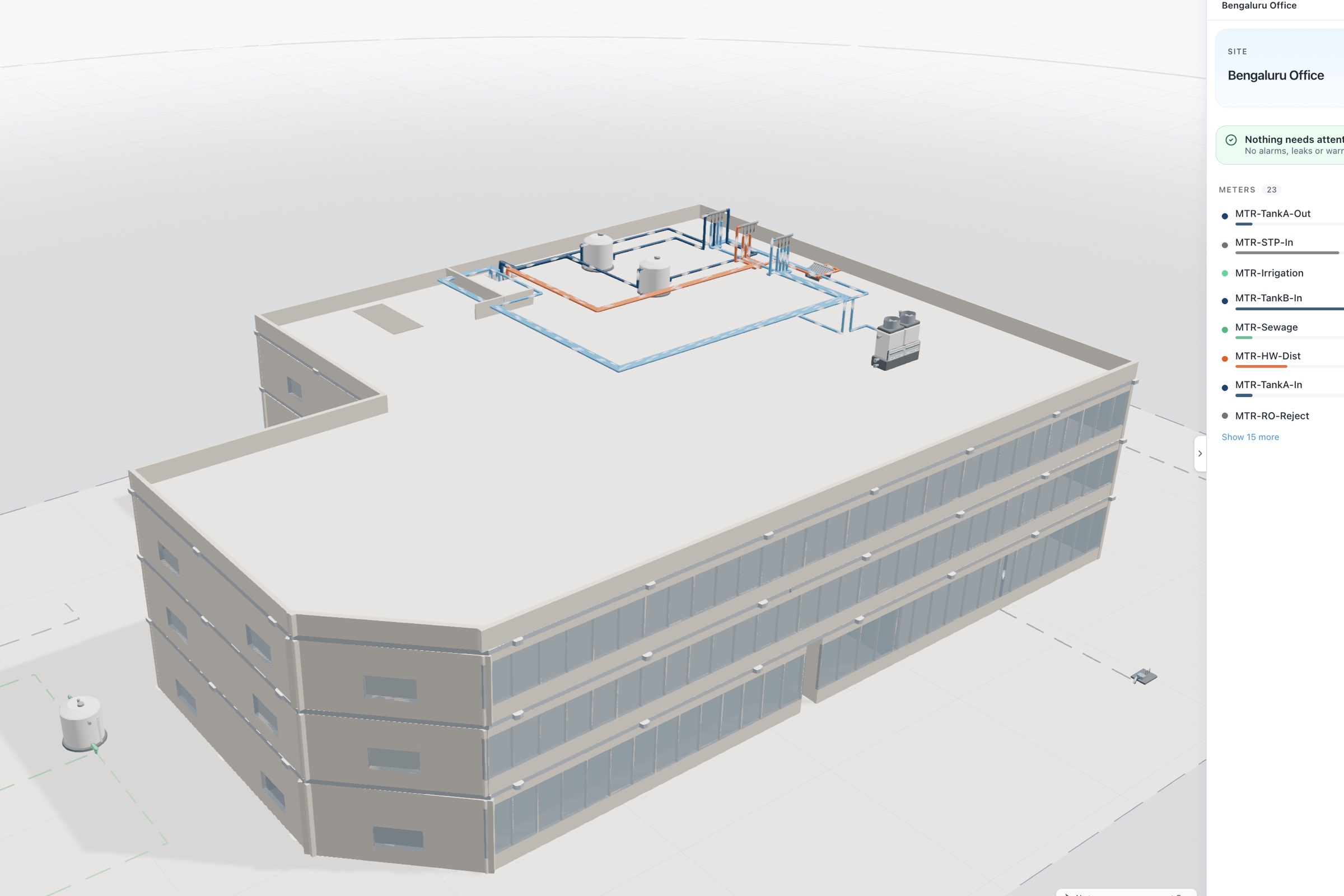
Facility data comes from meters, sensors and building systems. A facility intelligence platform reads existing meters and controllers over Modbus and BACnet, reads SCADA and historians read only, and adds wireless LoRaWAN sensors where nothing is measured. Each device is tied to a site, floor, zone and asset, and reports its own health so gaps are visible.
Between the platform and the EHS suite, the cleanest pattern is a hand-off, not a merge. The platform raises alerts and exports period records. The accountable person decides whether an event meets the criteria for an EHS record, raises it in the suite and attaches the measured evidence. Many suites accept imports or attachments; some teams also forward alerts. Maintenance findings go to the CMMS.
Data quality is the part teams most often skip. A record with silent gaps is worse than no record, because it looks complete. Each sensor should report its connection rate and battery or supply health, gaps should be flagged rather than filled in quietly, and exports should carry the data quality alongside the readings. An auditor who sees a gap explained will usually accept it. One who finds an unexplained gap will question everything else.
Standards that ask for measured evidence
- ISO 14001Monitoring, measurement, analysis and evaluation of environmental performance.
- ISO 50001Energy performance indicators and baselines, which need metered data.
- ISO 45001Monitoring of the work environment where it affects health and safety.
- Sustainability disclosuresFrameworks such as CSRD and BRSR increasingly ask for figures that trace to a meter.
Where Aqueduct fits
Aqueduct is a facility intelligence platform, not an EHS suite. It does not run incidents, permits, audits, training or chemical registers, and it does not file returns. It supplies the continuous environmental, air, water and energy evidence an EHS program relies on.
aQ Core holds the hierarchy of site, floor, zone and device, with sensor health on every device. aQ AirSafe measures workplace air per zone, with exposure in zone-hours. aQ WaterGuard reconciles water and effluent in a live balance. aQ EnergySmart meters and baselines energy against weather. aQ Assurance keeps the record and exports it for any period; your team or consultant files and certifies.
Aqueduct runs across 275+ sites in 21 countries. Organizations keep their EHS suite, keep their BMS and SCADA and read from them, and add measurement where it is missing. Where control is enabled, with owner approval, Smart Controls can act on simple loads such as extract fans, with every command logged.