What is a smart building platform, and how is it different from a BMS
 Milvian AI teamFacilities and infrastructure intelligence

A smart building platform is software that brings data from meters, sensors and existing building systems into one model of the building, then uses it to baseline, diagnose, report and, where control is enabled with owner approval, act. A BMS controls equipment within one building. The platform sits above it, across utilities and sites, and turns control into measured results.
Why the term smart building platform is so slippery
Smart building platform is one of the most stretched terms in facilities technology. It has been used for occupancy apps, room booking, tenant experience portals, IoT sensor dashboards, energy analytics and full building operating systems. A buyer comparing three smart building platforms may be comparing three products that share nothing except the label.
For a facility team, the useful definition is narrower. A smart building platform is the layer that knows what is physically happening in the building, across equipment, utilities and spaces, and can do something about it. It reads data from everything that emits telemetry, models how the systems connect, and turns that into decisions that are measured and verified.
That definition puts it next to the BMS rather than in competition with it. The BMS runs the equipment. The platform knows what the equipment, and the rest of the building, is actually doing.
The difference shows up in the questions each can answer. A BMS can tell you that air handler 3 is running and its supply air is at setpoint. A platform can tell you that air handler 3 has run through four empty nights, that the floor it serves used more energy than its weather-adjusted baseline, and that the cost of the difference is visible on this month's bill.
What a real smart building platform must do
| Requirement | Why it matters | Question to ask a vendor |
|---|---|---|
| Ingest anything that emits telemetry | Buildings mix meters, sensors, controllers and gateways from many makers | Which device types and protocols can you onboard, and who does it |
| Model the building, not just the points | Readings without a model of sites, floors, zones and systems cannot be explained | Show me how a sensor is tied to a zone, a floor and a system |
| Cover energy, water and air | Most waste and most risk sits across utilities, not inside one | Do you meter water and measure air quality in the same platform |
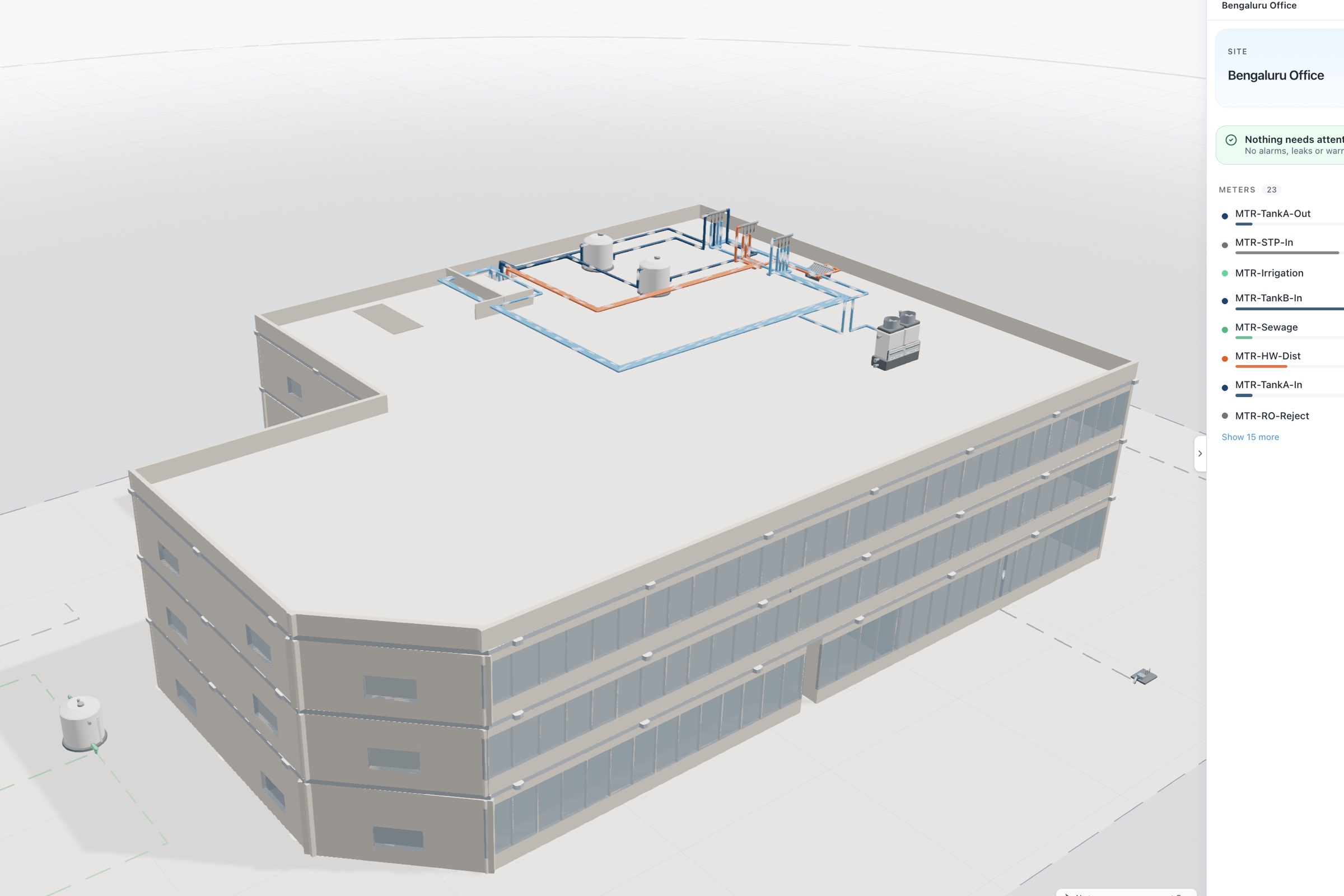
| Live digital twins | A schematic of the real system shows where loss happens | Can I see the water balance or electrical single line for my site |
| Weather-normalized baselines | Raw comparisons mislead in both directions | How are baselines built and how are savings verified |
| Diagnosis in plain language | Teams act on causes, not on charts | What does a finding look like and where does it go |
| Governed control | Acting is the point, but only safely | What approval, lockouts and command history do you provide |
| Portfolio and multi-site views | Owners compare buildings, not just floors | How do you normalize sites of different sizes and uses |
Smart building platform vs BMS
| Dimension | BMS | Smart building platform |
|---|---|---|
| Main purpose | Run equipment sequences and hold setpoints | Measure, diagnose, verify and act across the building |
| Scope | Mostly HVAC, sometimes lighting | Energy, water, air quality, occupancy and equipment |
| Data model | Control points | Sites, floors, zones and devices with systems modeled on top |
| History | Weeks of trends on a local server | Long histories suitable for baselines |
| Sites | Usually one per installation | Whole portfolio in one view |
| Savings | Not measured | Verified against weather-normalized baselines |
| Control | Direct and local | Through the BMS or field devices, where enabled, with approval |
How to evaluate a smart building platform
- Define the decisions it must supportWrite down the questions the facility, finance and sustainability teams cannot answer today. A platform is only smart if it answers them.
- Survey what existsList controllers, meters, sensors and networks. The platform's value depends on what it can reach and what needs adding.
- Check the data modelAsk how the platform represents your buildings. If it shows a list of devices with no floors, zones or systems, diagnosis will be shallow.
- Test on a real siteWatch it explain a real anomaly, including one caused by a sensor fault. Data health is part of intelligence.
- Measure a resultRun a pilot with a baseline agreed in advance and a defined measure of success.
Evaluation scorecard
| Criterion | Weight | What good looks like |
|---|---|---|
| Breadth of ingest | High | Meters, sensors, BACnet and Modbus devices and LoRaWAN, all in one store |
| Building model | High | Site, floor, zone and device hierarchy on real floor plans |
| Utility coverage | High | Energy, water and air quality in the same platform |
| Analytics depth | High | Baselines, digital twins and plain-language findings |
| Control governance | Medium | Owner approval, lockouts and command history |
| Usability | Medium | A plain-language assistant and views a non-engineer can read |
| Openness | Medium | Export and API access to all data |
Integration and data
A smart building platform should never ask you to throw away working systems. It reads the BMS over BACnet or Modbus, takes meter and sensor data over wired or LoRaWAN networks, reads SCADA where water or process plants have it, and writes work into the CMMS. Whether to keep or replace the BMS is a separate decision, made on the condition of the controllers.
Pay attention to data health. Wireless sensors run on batteries and gateways go offline. A platform that shows each device's connection rate and battery level, and where it sits on the floor plan, lets the team fix the right device instead of walking the building.
Control is the last integration question. Simple loads such as exhaust fans and lighting circuits can be switched by LoRaWAN relays. Complex equipment such as air handlers, rooftop units, chiller plants and VAV boxes is reached through BACnet or Modbus field devices. In both cases, ask how commands are approved, how equipment is protected from short cycling and how you can see afterwards whether each command actually ran.
Compliance and reporting
Smart building platforms increasingly carry the evidence for certifications and regulation: LEED and WELL for building performance and indoor environment, ASHRAE 62.1 for ventilation, ENERGY STAR Portfolio Manager for benchmarking, building performance standards, and GRESB or CSRD for investor and corporate reporting.
The platform supplies continuous, measured data and a record of what changed. It does not certify anything. The owner, the assessor or the authority makes that judgment.
Where Aqueduct fits
Aqueduct is a facility intelligence platform, built as an integrated command and control centre for a facility: awareness first, then optimization and control. aQ Core locates every site, sensor and meter, collects their data and holds the site, floor, zone and device model. aQ EnergySmart, aQ WaterGuard and aQ AirSafe build on it with live digital twins, weather-normalized baselines and analytics, and aQ Assistant answers questions in plain language using the same data.
Smart Controls acts through LoRaWAN relay switches or Modbus and BACnet field devices, where control is enabled, with owner approval, with lockouts and a full command history. Aqueduct can work alongside your BMS, replace it or be built in at design stage, and it runs at 275+ sites in 21 countries.