The best water leak detection system for commercial buildings
 Milvian AI teamFacilities and infrastructure intelligence

The best water leak detection system for commercial buildings combines flow-based detection, a live water balance and overnight flow analysis, with spot sensors where water can pool. It locates losses by riser, floor or zone, alerts the night a leak starts, prices the loss, routes it to the CMMS and, where the owner approves, can close a valve with a logged command.
Why leak detection in commercial buildings is harder than it looks
Commercial buildings leak in two very different ways. Some leaks escape: a burst pipe, a failed fitting above a ceiling, an overflowing tank. They cause damage, and the cost of repairs and disruption is usually far larger than the water. Other leaks stay inside the system: a running toilet, a stuck fill valve on a cooling tower, an irrigation zone that never shuts off, a slow leak on a buried main. They cause no visible damage but run every hour of every day.
Most buildings rely on one boundary meter and a monthly bill, which catches neither kind in time. Spot sensors under tanks help with the first kind but only where they are placed. The second kind needs flow measurement and a model of what the building should be using.
A good leak detection system has to handle both, across buildings of different ages, and without flooding the team with alarms nobody trusts.
Response time is the real measure. A leak found the night it starts costs a fraction of one found on the next bill, and a burst found in minutes costs a fraction of one found on Monday morning. That means the system has to watch continuously, know what normal looks like for each building at each hour, and tell someone who can act, with a location they can walk to.
What the best water leak detection system for commercial buildings must do
| Requirement | Why it matters in commercial buildings | Question to ask a vendor |
|---|---|---|
| Flow-based detection | Most losses never touch the floor. | Do you detect leaks from flow patterns, not only from water on the floor? |
| Live water balance | Unaccounted loss shows where water goes missing. | Can you compare main supply with the sum of submetered uses in real time? |
| Overnight and weekend analysis | An empty building should use almost no water. | Do you alert on flow above the expected overnight pattern? |
| Location, not just a building alarm | Teams need to know where to go. | Can you narrow a leak to a riser, floor or zone? |
| Spot sensors where water pools | Tanks, plant rooms and risers need physical detection. | Can spot sensors sit on the same platform as flow data? |
| Automatic shutoff with guardrails | Closing water in an occupied building has consequences. | Is shutoff limited to valves we approve, and is every command logged? |
| Loss priced in money | Finance acts on currency. | Do you price each leak in our tariff? |
| Trustworthy alerts | False alarms train people to ignore alerts. | How do you show device health and tune alerts to each building? |
The categories buyers compare
- Spot leak sensorsCheap, simple and reliable where water can pool. They only find water that has already escaped, and only where placed.
- Automatic shutoff valvesStop a burst quickly at the point of supply. On their own they act on simple rules and can shut water to an occupied building.
- Smart utility metersGive interval data at the boundary. They show that the building is using more, not where.
- BMS alarmsCan alarm on tank levels or pump runtime. Rarely set up for flow analysis or water balance.
- Acoustic leak surveysSpecialists pinpoint buried and hidden leaks on survey days. New leaks between surveys go unseen.
- Facility intelligence platformsFlow, balance, overnight analysis, spot sensors and approved shutoff on one model, with losses priced and routed to the CMMS.
How to evaluate a leak detection system
- Map supply and riskTrace the main, risers, tanks, towers, irrigation and high-risk areas such as plant rooms and spaces above server rooms or retail.
- Combine flow and spot sensingPlan clamp-on flow meters on the main and risers, and spot sensors where water would pool.
- Learn the building's nightRun long enough to learn overnight and weekend patterns before judging alert quality.
- Test with a controlled drawOpen a known tap for a known time out of hours and check the system detects, locates and prices it.
- Agree shutoff rules lastOnly after alerts are trusted, decide which valves may close automatically, and under what conditions.
Leak detection system scorecard
| Criterion | Weight | What good looks like |
|---|---|---|
| Flow-based detection | High | Losses found inside the system, not only on the floor |
| Location | High | Leak narrowed to riser, floor or zone |
| Alert quality | High | Tuned to each building's pattern, few false alarms |
| Water balance | Medium | Supply against submetered uses, unaccounted loss shown |
| Spot sensors | Medium | On the same platform as flow data |
| Shutoff guardrails | Medium | Owner approved valves, logged commands |
| Loss in money | Medium | Each leak priced in your tariff |
| Data trust | Low | Device health and battery visible per sensor |
Integration and data
Clamp-on ultrasonic flow meters fit on mains and risers without cutting pipe or shutting water off. LoRaWAN spot sensors and battery flow devices reach basements, risers and roofs without new cabling, and existing smart meters and BMS points are read over Modbus or BACnet.
Alerts should reach the right people by location and severity, and become work orders in the CMMS with the flow data attached. Device health matters more in leak detection than almost anywhere else, because a sensor with a flat battery reports nothing, and nothing looks exactly like no leak.
Ask how alerts are tuned. A hotel, an office, a hospital and a mall each have their own overnight pattern. Alerts that learn each building's normal flow by hour and day of week find small continuous leaks without waking the on-call engineer for every cleaning shift.
Standards and reporting
AWWA M36 gives a structure for water audits and separating real losses from apparent ones. LEED, BREEAM and WELL reward measured water performance, and GRESB and ENERGY STAR Portfolio Manager track water across portfolios. Insurers increasingly ask what leak protection a building has.
A leak detection system supplies measured evidence of losses found and fixed. Owners, auditors and insurers make the judgments.
Where Aqueduct fits
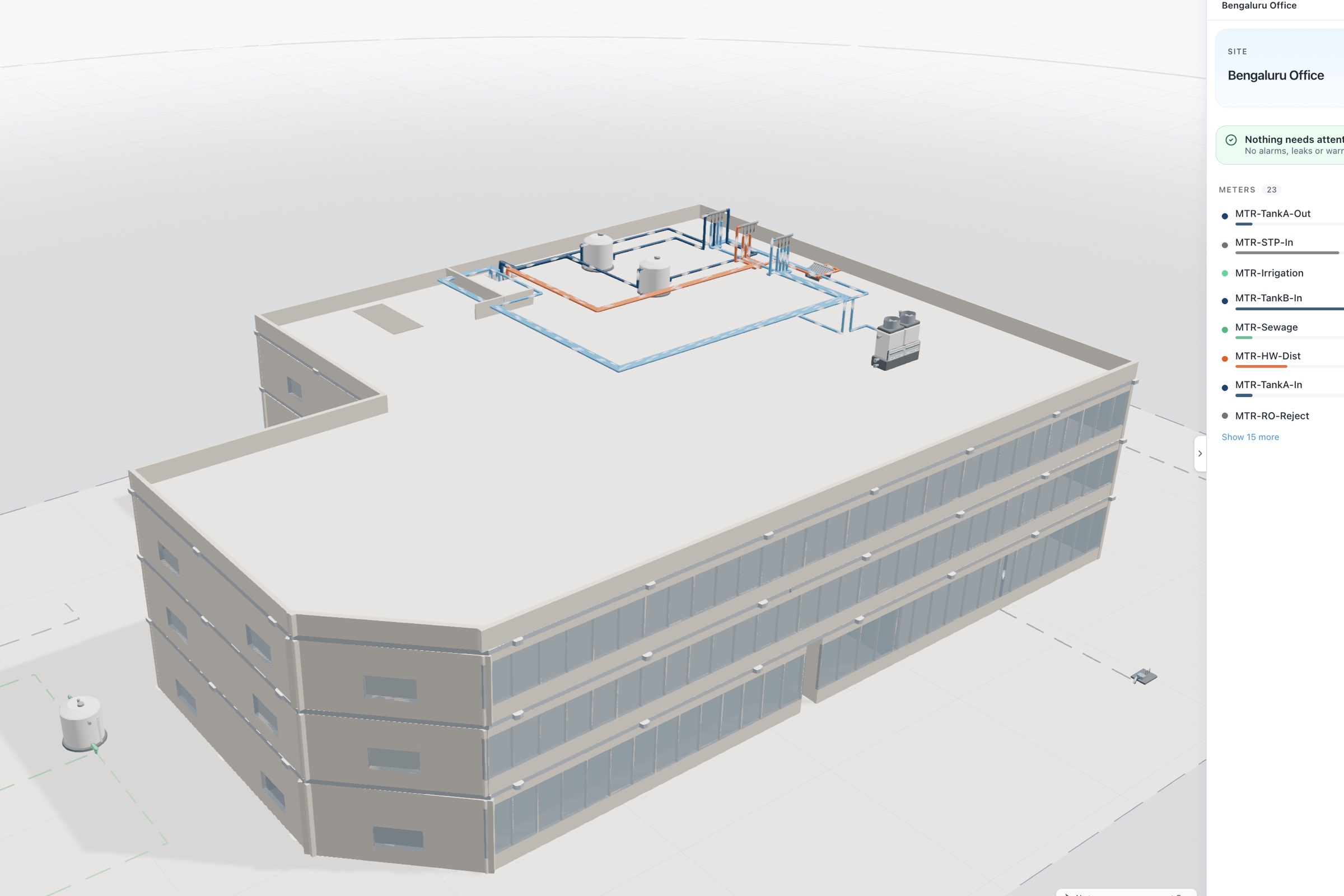
aQ Core maps each building as sites, floors, zones and devices, and shows device health for every sensor, including connection rate and battery voltage. aQ WaterGuard builds a live water digital twin with a water balance equation, main supply against each floor, the fire system and other metered uses, so unaccounted loss is visible as its own term and updates from telemetry. Analytics drill from line to month, day and hour, so overnight flow is easy to see. Rate configuration prices every loss.
Owners keep existing meters and BMS, replace failed devices or build metering in at design. Where control is enabled, with owner approval, Smart Controls can close approved valves through LoRaWAN relays or field devices, with lockouts and command history so every action is auditable. Aqueduct serves a commercial real estate developer with 20M+ sq ft and one of India's top hospital chains.
A first engagement usually starts with flow meters on the main and key risers, spot sensors where water would pool, and a few weeks to learn each building's overnight pattern. A controlled test draw confirms detection and location. Automatic shutoff, if wanted, is agreed last, on specific valves, once the team trusts the alerts.