The best stadium intelligence platform, and what the ideal stadium management system looks like
 Milvian AI teamFacilities and infrastructure intelligence

The best stadium intelligence platform puts energy, water, air and plant on one live data layer that follows the event calendar. It baselines each system against weather and events, shows match-day water in a balance, ventilates hospitality and concourses to the crowd, shifts peaks before gates open, finds faults on dark days, routes them to the CMMS, and acts on equipment only where control is enabled, with owner approval.
Why a stadium is a hard case for facility systems
A stadium lives two lives. On most days it is a large, mostly empty building with offices, a store, a museum or tours, and a pitch to look after. On event days it fills with tens of thousands of people in a few hours, every concession, washroom, lift and hospitality suite runs at once, and then it empties again. The plant has to serve both lives without wasting energy on the quiet days or failing on the busy ones.
That swing breaks the assumptions most building systems are built on. Schedules written for a weekly pattern miss the fixture list. Peak demand is set in the hour before gates open, when catering, lighting, broadcast and cooling all start together. Water use spikes at half time in a pattern that hides leaks and running urinals. Concourse and hospitality air goes from empty to crowded in minutes. And a fault in a chiller or an air handler found at kick-off is far more expensive than one found on a Tuesday.
A stadium also has more parties than most buildings. The owner, the operator, the tenant clubs, concession partners, broadcasters and event promoters all draw on the same services. Attributing what each one uses is part of the job.
What the best stadium intelligence platform must do
| Requirement | Why it matters in a stadium | Question to ask a vendor |
|---|---|---|
| Follow the event calendar | Loads and occupancy follow fixtures, not weekdays | Can event schedules drive baselines, alerts and automations? |
| Shift event-day peaks | Demand charges are set in the hour before gates open | Can you see peak demand building and sequence loads where approved? |
| Balance match-day water | Half time hides leaks and running fixtures | Do you build a water balance with unaccounted loss as a live number? |
| Ventilate to the crowd | Hospitality and concourses go from empty to full in minutes | Do you read CO2 and occupancy per zone and act where approved? |
| Find faults on dark days | A failure at kick-off is the worst time to find it | Do you run fault detection between events and route it to the CMMS? |
| Attribute use by party | Clubs, concessions and promoters share services | Can you sub-meter and bill tenants and events? |
| Baseline against weather | A hot season looks like waste without normalization | Are baselines built from degree days and event activity? |
| Keep the existing BMS | Stadium BMS investments are large and recent | Do you read BACnet and Modbus without replacing it? |
| Audit every command | Event days leave no room for surprise | Is there a command history and lockout protection? |
The categories of tools stadium operators compare
- Traditional BMS and BAS from controls manufacturersReliable, proven control of air handlers, chillers and lighting, with trusted local sequences. Built for control engineers, they rarely cover water, sub-metering or portfolio analytics, and they keep data inside one vendor's world.
- Standalone EMS dashboardsGood at interval energy charts and alarms for one utility. They usually stop at display, without water, air quality, digital twins or a path to control.
- IoT monitoring platformsFast to deploy wireless sensors with tidy charts. Strong for one problem, weaker on balances, baselines, control and the integration that turns a chart into a work order.
- CMMS and EAMThe right home for work orders, assets and maintenance history. They rely on people or other systems to tell them something is wrong.
- Utility bill services and consultantsUseful for audits, bill collection and expert judgment. Monthly and periodic, so they explain what happened long after it happened.
- Facility intelligence platformsOne data layer across water, energy and air, with live digital twins of the systems, weather-normalized baselines, alerts that route to the CMMS and control where control is enabled, with owner approval. The difference is breadth: the same platform follows the bowl, the concourse, the plant and the pitch.
How to evaluate a stadium intelligence platform
- Walk the venue on an event day and a dark daySee the plant at full load and at rest. Note what runs on dark days that does not need to.
- Gather bills and the fixture listTwelve months of utility bills and the event calendar give a baseline that separates weather, events and waste.
- Map the systems and the metersCentral plant, air handlers serving the bowl and hospitality, concourse washrooms, pitch irrigation, kitchens and lighting. Mark what is metered.
- Pilot across a run of eventsPick a stand or the hospitality level. Run through several events and dark days so patterns show.
- Judge on measured resultsPeak demand on event days, dark-day base load, unaccounted water and faults found before events, each against the baseline.
Stadium intelligence platform scorecard
| Criterion | Weight | What good looks like |
|---|---|---|
| Event awareness | 20% | Event calendar drives baselines, alerts and automations |
| Energy and peak demand | 15% | Event-day peaks visible and shifted where approved, dark-day base load found |
| Water balance | 15% | Match-day water reconciled, leaks and running fixtures flagged |
| Air and comfort | 10% | Hospitality and concourse air read against occupancy |
| Fault detection and CMMS | 15% | Faults found between events and routed with a fix |
| Integration | 15% | Reads the existing BMS, meters and event systems |
| Control and audit | 10% | Where control is enabled, with owner approval, command history and lockouts |
Integration and data in a stadium
Most stadiums already have a BMS on central plant and air handlers, sometimes more than one after extensions. A stadium intelligence platform should read them over BACnet and Modbus rather than replace them. Main and sub-meters for electricity, gas and water are read the same way. Where coverage is thin, wireless LoRaWAN sensors and clamp-on meters fill gaps on concourses, washrooms, kitchens and irrigation without cable runs through the stands.
Event scheduling systems are an input. They tell the platform when the bowl will fill, so baselines and automations can follow the fixture list. Findings go to the CMMS the operations team already uses. Tenant and concession meters feed billing, so each party sees its own share.
The question of keep versus replace is practical. If the BMS is sound, keep it and read from it. If it is near end of life, replace it with open protocol controllers the platform can talk to. In a new stadium, design the measurement layer in from the start.
Compliance and reporting for stadiums
- ISO 50001Energy baselines and performance indicators, measured and normalized, support an energy management system.
- LEED O+MOperational energy, water and indoor air data support certification in operation.
- ASHRAE 62.1Ventilation for occupied spaces such as hospitality and offices, with continuous data showing performance in use.
- Sustainability reportingScope 1 and 2 energy and water figures per event and per season, traced to meters.
Where Aqueduct fits
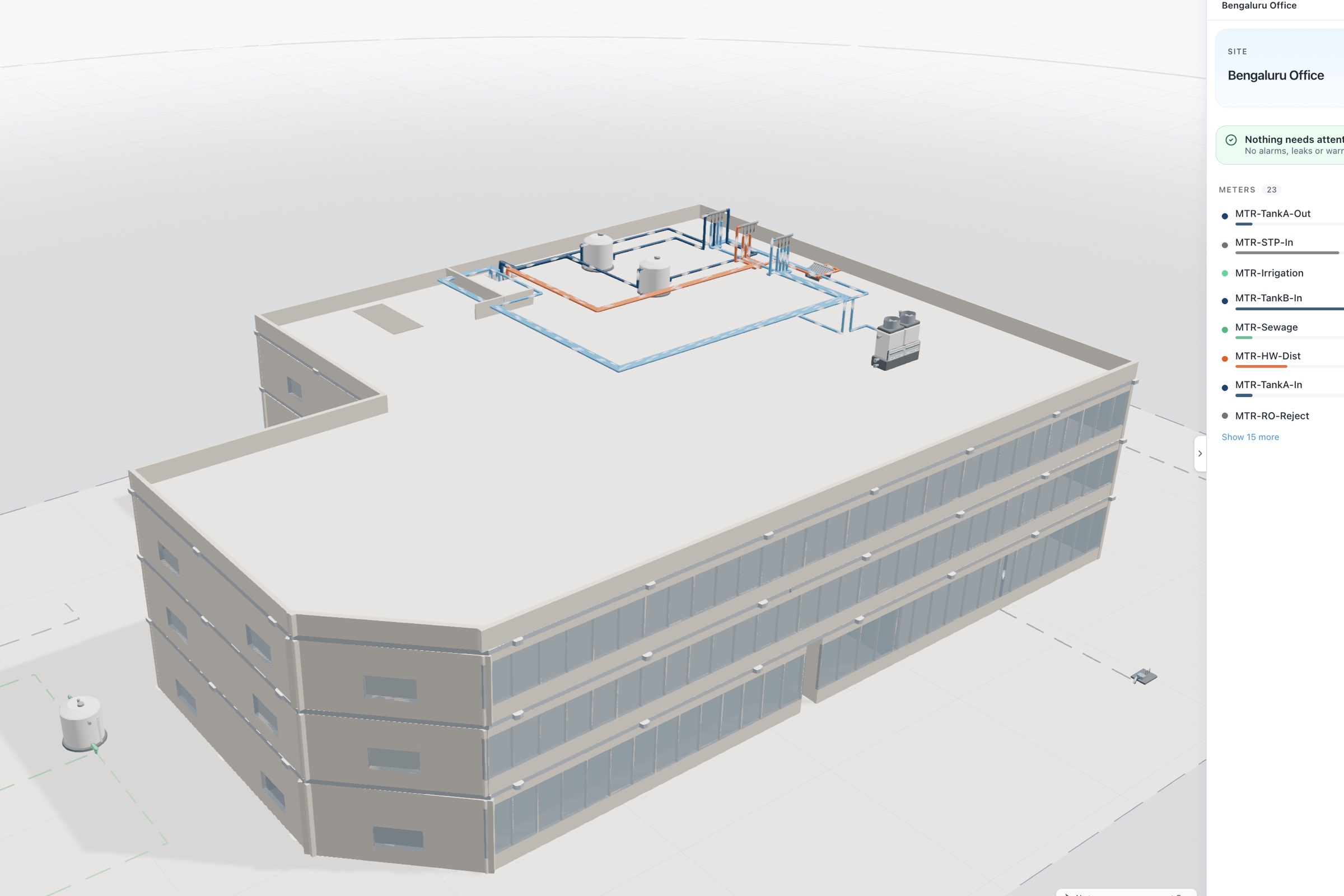
Aqueduct is a facility intelligence platform built for exactly this kind of building. aQ Core holds the venue as site, floor, zone and device, so every reading belongs to a stand, a concourse or a plant room. aQ EnergySmart shows the electrical single line live, with peak demand and power factor, and builds weather-normalized baselines from bills on day one. aQ WaterGuard builds the water balance with unaccounted loss as a live number. aQ AirSafe reads hospitality and concourse air against occupancy. aQ PredictIQ watches plant for drift between events.
Stadiums can keep their BMS and read from it, replace an end-of-life system, or build the layer into a new venue. Where control is enabled, with owner approval, Smart Controls can pre-cool before gates open, sequence loads to hold peak demand and set back plant on dark days, with occupancy and the event schedule driving the rules, lockout protection on equipment and every command recorded in the command history.