The best hospital facility intelligence platform for plant, clinical spaces and water
 Milvian AI teamFacilities and infrastructure intelligence
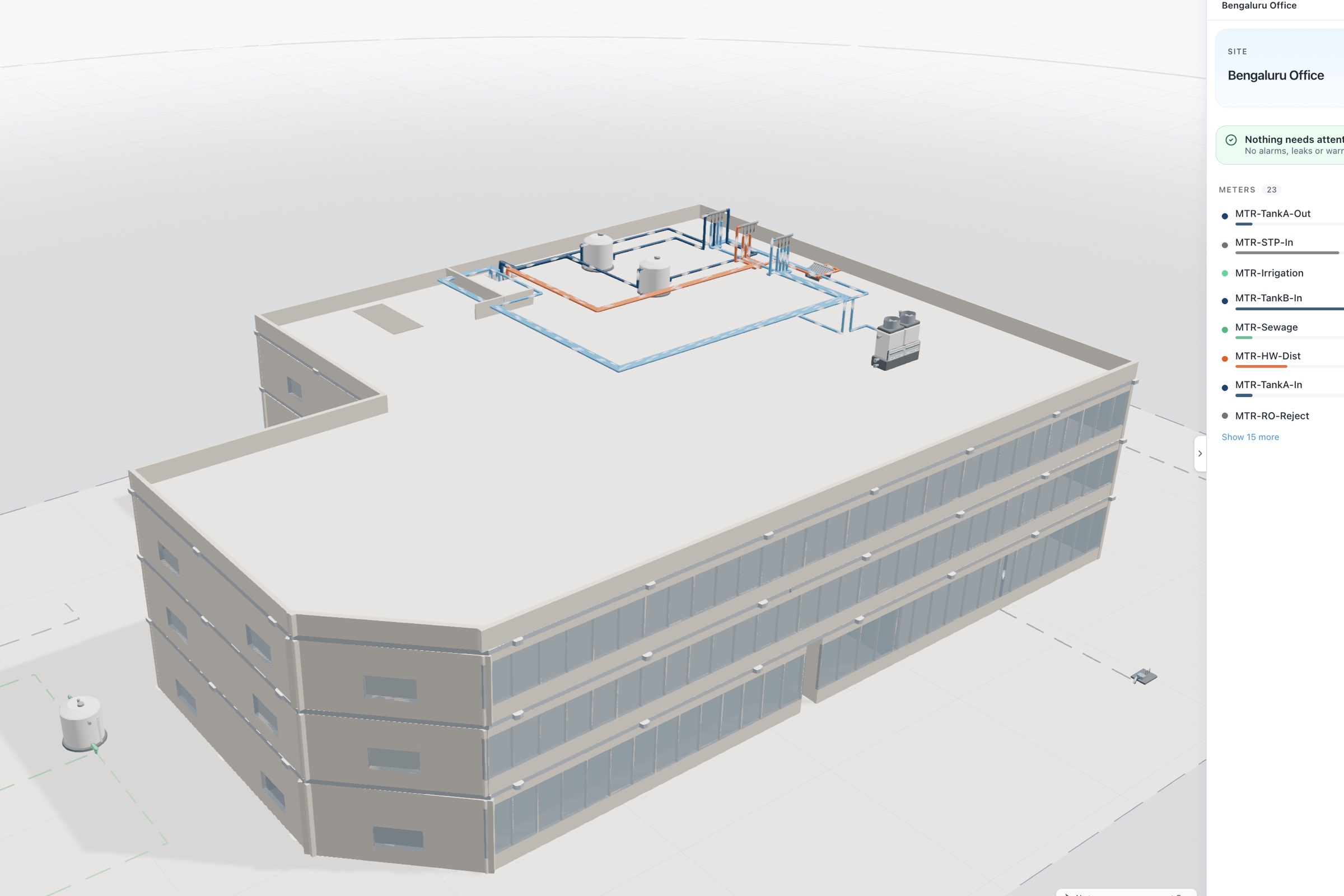
The best hospital facility intelligence platform puts central plant, air handlers, critical space conditions, hot and cold water loops and energy onto one live data layer. It baselines energy against weather, keeps room conditions as evidence, finds plant faults before they reach patients, routes them to the CMMS, and acts on equipment only where control is enabled, with owner approval and away from clinical risk.
Why a hospital is a hard case for facility systems
A hospital never closes and never forgives. Operating rooms, isolation rooms, sterile processing and pharmacy have temperature, humidity, air change and pressure requirements. Hot water has to be held at temperatures that control Legionella. Steam goes to sterilization, humidification and kitchens. Imaging, labs and data rooms add heavy loads, and emergency generators must be tested on a schedule.
The facility team runs all of this with a BMS that was set up for control, a CMMS for work orders, paper or spreadsheet logs for rounds, and utility bills that arrive a month late. Energy is one of the few large operating costs a hospital can influence, but the team cannot see which system drives it. When a surveyor asks for room history or finance asks whether last year's project worked, the answer has to be assembled by hand.
A hospital facility intelligence platform joins these pieces. It is not a clinical system and should never act like one. Its job is to make the building visible, find waste and faults early, keep evidence, and support safe action.
What the best hospital facility intelligence platform must do
| Requirement | Why it matters in a hospital | Question to ask a vendor |
|---|---|---|
| Read the existing BMS | Air handlers and plant already expose many points | Do you read BACnet and Modbus without changing sequences? |
| Meter each major system | Plant, air handlers, steam and hot water each need their own baseline | Which systems can you meter and baseline separately? |
| Normalize for weather | A mild year hides waste and a hot one punishes savings | Is the baseline built on degree days for our location? |
| Keep critical space evidence | Surveys ask for room history and deviations | Can you keep conditions, deviations and closures per room? |
| Support water safety | Loop temperatures are Legionella control points | Do you trend hot and cold loops and flag low-use outlets? |
| Find plant faults early | Failures near clinical spaces carry patient risk | Do you diagnose faults and route them to our CMMS? |
| Separate clinical from non-clinical action | Savings must never touch patient safety | How do you keep control out of clinical spaces unless approved? |
| Cover a hospital group | Groups need to compare sites fairly | Can every hospital be ranked against its own baseline? |
The categories of tools hospital facility teams compare
- Traditional BMS and BAS from controls manufacturersReliable, proven control of air handlers, chillers and lighting, with trusted local sequences. Built for control engineers, they rarely cover water, sub-metering or portfolio analytics, and they keep data inside one vendor's world.
- Standalone EMS dashboardsGood at interval energy charts and alarms for one utility. They usually stop at display, without water, air quality, digital twins or a path to control.
- IoT monitoring platformsFast to deploy wireless sensors with tidy charts. Strong for one problem, weaker on balances, baselines, control and the integration that turns a chart into a work order.
- CMMS and EAMThe right home for work orders, assets and maintenance history. They rely on people or other systems to tell them something is wrong.
- Utility bill services and consultantsUseful for audits, bill collection and expert judgment. Monthly and periodic, so they explain what happened long after it happened.
- Facility intelligence platformsOne data layer across water, energy and air, with live digital twins of the systems, weather-normalized baselines, alerts that route to the CMMS and control where control is enabled, with owner approval. In a hospital that means evidence and savings from the same data, with control kept away from clinical risk.
How to evaluate a hospital facility intelligence platform
- Map systems, spaces and standardsCentral plant, air handlers by area served, critical spaces with their standards, and water loops.
- Gather bills and logsTwelve months of bills set the baseline. Round logs and CMMS history show where faults recur.
- Agree the rules with clinical teamsEngineering, infection prevention and clinical leadership agree which spaces are read only.
- Pilot on the plant and one departmentCentral plant shows energy value; one department shows the evidence side.
- Judge on verified resultsEnergy against baseline, faults found and closed, and a room history a surveyor would accept.
Hospital facility intelligence scorecard
| Criterion | Weight | What good looks like |
|---|---|---|
| BMS and plant integration | 15% | Existing BMS read, plant metered by system |
| Energy baselines | 20% | Weather-normalized, per system, verified at the meter |
| Critical space evidence | 15% | Room conditions with deviations and closures |
| Water safety support | 10% | Loop temperatures and low-use outlets trended |
| Fault detection and CMMS | 15% | Diagnosed faults routed with a fix |
| Clinical safety boundaries | 15% | Read only in clinical spaces unless agreed |
| Group view | 10% | Every site ranked against its own expected use |
Integration and data in a hospital
Keep the BMS. The platform reads it over BACnet and Modbus, adds metering on plant and panels with current transformers, and adds wireless LoRaWAN sensors in spaces the BMS does not cover, such as waiting areas, staff rooms and hot water loops. Each sensor reports its own health, so engineering knows which device needs attention before a gap opens in the record.
Work orders go to the hospital's CMMS. Environment of care evidence is exported for the compliance team. Where control is added, it goes through field device controllers on non-clinical equipment first, such as plant sequencing, back-of-house ventilation and lighting, and only reaches clinical areas if engineering and infection prevention agree.
Replacement is a real option when a BMS is at end of life, and new buildings or wings are the right moment to build the measurement layer in from design.
Compliance and reporting in hospitals
- Environment of careRoom-level records support Joint Commission and NABH facility standards. The surveyor decides.
- VentilationASHRAE/ASHE 170 for health care spaces and ASHRAE 62.1 for others, shown in operation.
- Energy managementISO 50001 and ENERGY STAR benchmarking from metered, normalized data.
- Water managementLoop temperature trends as evidence for the program built on ASHRAE 188.
Where Aqueduct fits
Aqueduct is a facility intelligence platform, not a clinical system. aQ EnergySmart meters and baselines plant and systems against weather, with savings verified at the meter. aQ AirSafe reads room conditions and air quality against occupancy. aQ WaterGuard trends hot and cold loops and flow. aQ Assurance keeps temperature and pressure records, deviations with closure, and exports for any period. aQ PredictIQ watches chillers, pumps and air handlers for drift. aQ Core holds every hospital, floor, zone and device, with sensor health visible.
Aqueduct serves one of India's top hospital chains, with 22 hospitals and 9 clinics. Hospitals keep their BMS and read from it, replace an end-of-life system, or build the layer into a new wing. Where control is enabled, with owner approval, Smart Controls starts with non-clinical equipment, with lockout protection and a full command history.