The best facility management software for FM service providers
 Milvian AI teamFacilities and infrastructure intelligence

The best facility management software for an FM service provider does more than schedule work. It measures energy, water and air at each client site, diagnoses faults and sends them into the provider's CMMS with a fix, verifies closure at the meter, proves savings per contract against weather-normalized baselines, and keeps each client's data separate while giving the provider one view across all of them.
Why FM service providers are a hard case
An FM service provider runs other people's buildings under contract. Each client has its own sites, systems, standards and reporting needs. The provider has to deliver hard and soft services, hit KPIs, keep the client informed and win the renewal, usually on tight margins and with technicians spread across many sites.
Most providers run a CMMS or CAFM for work orders and planned maintenance, plus whatever BMS and meters each client happens to have. That is enough to show work was scheduled and closed. It is not enough to show the work made a difference. Clients increasingly ask for energy and water savings, comfort and air quality, and sustainability data, and they expect the provider to prove it.
There is also a margin problem. Reactive call-outs, repeat visits to the same fault and technicians sent without a diagnosis all cost money. A provider that finds faults from data and sends the right technician with the right part protects its margin and its reputation.
Contract models are changing too. More clients ask for outcome-based or gain-share terms, where part of the fee depends on energy saved, comfort held or uptime delivered. Those contracts are only fair to both sides if the baseline is agreed up front, adjusted for weather and occupancy, and measured the same way every month. A provider without that measurement either avoids those contracts or signs them blind.
What the best FM software for service providers must do
| Requirement | Why it matters for an FM provider | Question to ask a vendor |
|---|---|---|
| Work across many clients | Each client's data must stay separate | How are clients, sites and permissions separated? |
| Feed your CMMS | Technicians already live in it | Can faults arrive in our CMMS with a diagnosis and fix? |
| Verify closure with data | A closed ticket is not a fixed fault | Can the equipment data confirm the fault cleared? |
| Prove savings per contract | Gain-share and KPIs need verified numbers | Are savings measured against weather-normalized baselines? |
| Read whatever each client has | Clients have different BMS and meters | Which protocols can you read without replacement? |
| Deploy quickly | Mobilization windows are short | How fast can a new client site be onboarded? |
| Report in the client's terms | QBRs need clear, comparable numbers | Can reports be produced per client and per contract? |
| Support control where agreed | Some contracts include optimization | Can you act on equipment with client approval and a command log? |
The categories of tools FM providers compare
- CMMS and CAFMWork orders, planned maintenance, assets and SLAs. The provider's operating system. Depends on people or systems to raise issues.
- IWMSSpace, lease and project management for large occupiers. Often client-owned and broad, less focused on plant data.
- Client BMSControls equipment on each site. Varies by client and vendor, rarely shared across a provider's portfolio.
- IoT monitoring add-onsQuick sensors for one service, such as washrooms or air. Often another login per client.
- Facility intelligence platformsOne data layer across every client site, with baselines, fault detection and verification, feeding the provider's CMMS and client reports.
How to evaluate FM software as a provider
- Pick one client and one service lineChoose a contract with an energy or comfort KPI and a cooperative client. A site with recurring reactive call-outs is a good test, because the data should explain them.
- Load bills and connect existing systemsBills give a day-one baseline. Read the client's BMS and meters.
- Connect to your CMMSRoute diagnosed faults into your existing work order flow.
- Run through a QBR cycleMeasure faults found, closures verified and savings against baseline.
- Scale to more clientsCheck onboarding time, data separation and reporting per client.
FM provider software scorecard
| Criterion | Weight | What good looks like |
|---|---|---|
| Multi-client structure | 15% | Clients separated, provider view across all |
| CMMS integration | 20% | Diagnosed faults arrive in your CMMS |
| Verified closure | 15% | Equipment data confirms the fix |
| Savings proof | 20% | Weather-normalized baselines per site and contract |
| Integration breadth | 10% | Reads each client's BMS and meters |
| Onboarding speed | 10% | New sites live quickly, with wireless where needed |
| Client reporting | 10% | Per-client reports in the client's terms |
Integration and data for providers
Each client site has its own mix of systems. The platform reads BMS over BACnet and Modbus and meters wherever they report, and adds wireless LoRaWAN sensors where coverage is thin. Installation is guided so each device is commissioned to the right client, site, floor and zone.
Faults with a likely cause and recommended fix flow into the provider's CMMS, so technicians keep their tools. When the ticket closes, the equipment data shows whether the fault actually cleared. Clients can have their own view, and the provider sees the whole book of business.
Data separation matters commercially as well as technically. A client should never see another client's sites, and a provider's central team should be able to compare performance across contracts without exposing client data in reports. Roles should cover the provider's managers, site technicians, the client's facility team and, where relevant, the client's tenants.
Mobilization is where many providers lose time. A platform that can take bills on day one, read existing systems in the first weeks and fill gaps with wireless sensors that do not need cabling lets a provider show value inside the first reporting period of a new contract.
Standards and reporting FM providers work with
- ISO 41001Facility management system requirements, supported by measured performance data.
- ISO 50001 and M&VEnergy performance and verified savings for gain-share and KPI contracts.
- SFG20 and ISO 55001Maintenance and asset management, informed by condition data.
- Client ESG reportingEnergy and water figures per site, traced to meters.
Where Aqueduct fits
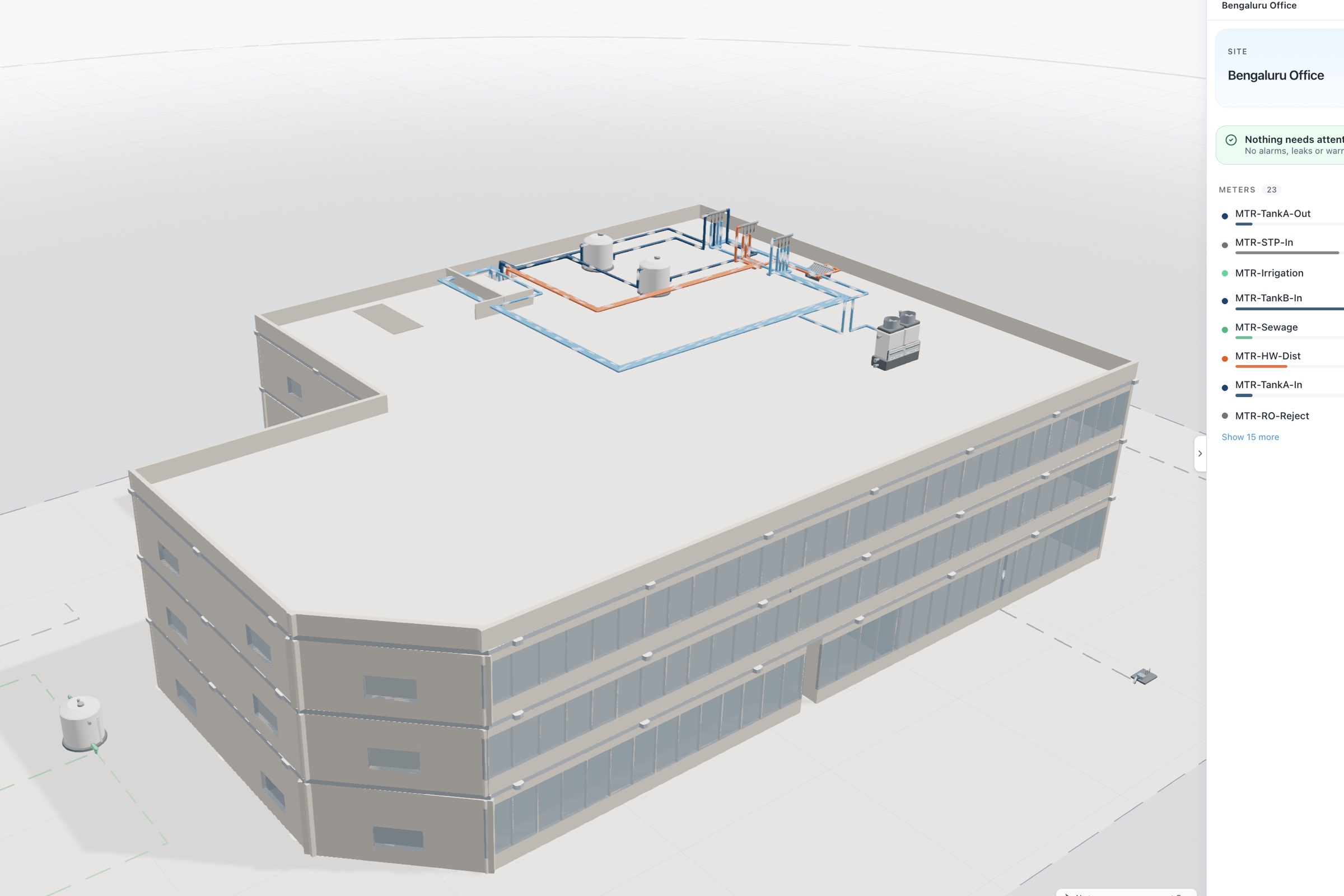
Aqueduct is a facility intelligence platform providers deliver across client portfolios. aQ Core holds each client's sites, floors, zones and devices with permissions kept separate, and aQ Atria guides technicians through installing and commissioning each device. aQ EnergySmart, aQ WaterGuard and aQ AirSafe baseline and monitor each site. Diagnosed faults arrive in the provider's CMMS, closure is confirmed by the equipment rather than the form, and savings are measured against weather-normalized baselines and verified at the meter.
Providers keep each client's BMS and read from it, replace end-of-life systems as a project, or build the layer into new sites. Where control is enabled, with owner approval, Smart Controls acts on equipment with occupancy-driven rules and a full command history the client can audit.
For the provider, the result is a different conversation at renewal. Instead of a list of tickets closed, the QBR shows faults found before the client noticed them, fixes confirmed by the equipment, energy and water against an agreed baseline, and air and comfort held in occupied zones. Billing Management can also support tenant recharges and bill validation where the contract includes them, which gives the provider another service to offer on the same data.