The best EHS monitoring software for distilleries: effluent, ZLD and the balance that has to close
 Milvian AI teamFacilities and infrastructure intelligence
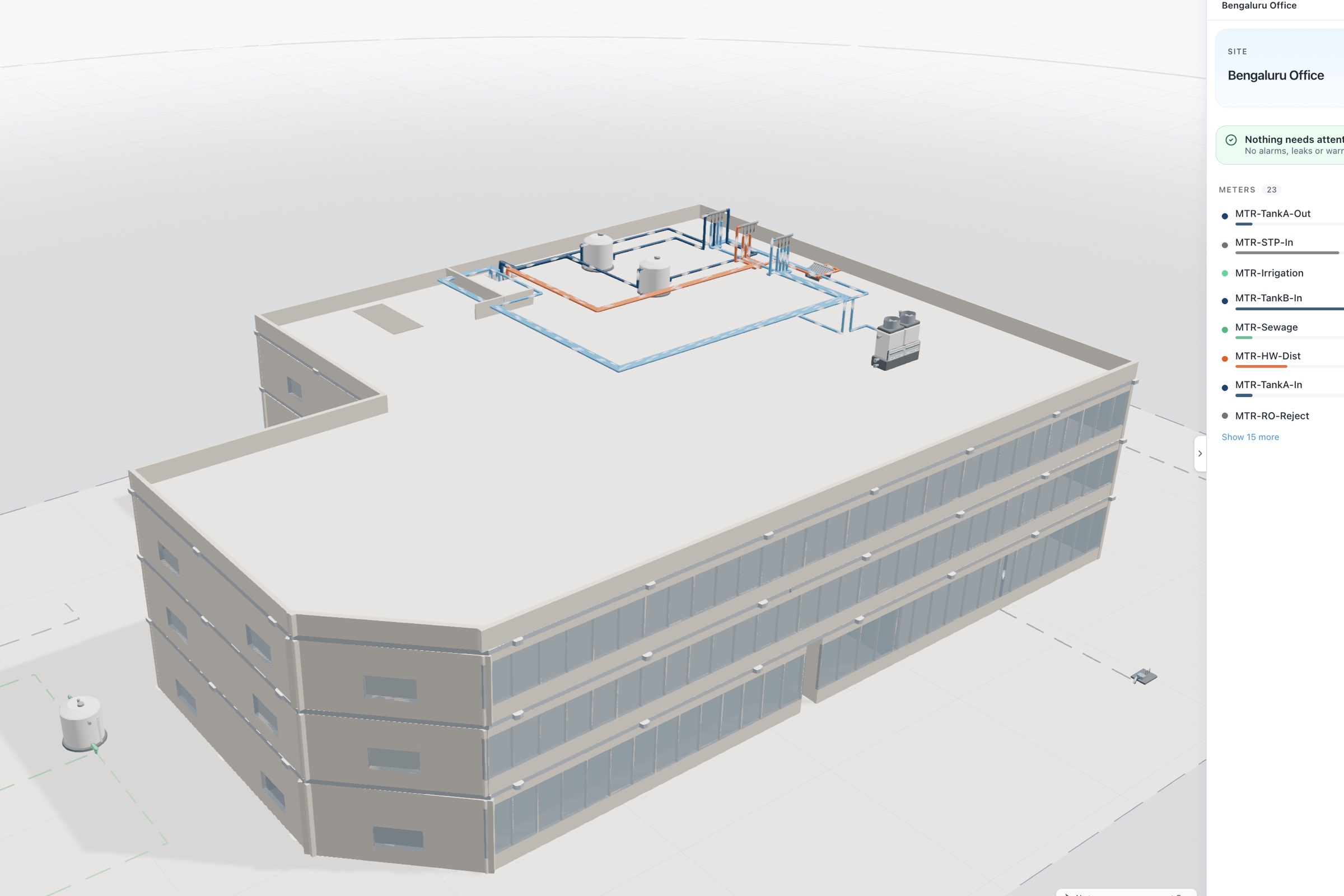
The best EHS monitoring software for a distillery meters every water entry, process stream, spent wash destination and discharge continuously, so the zero liquid discharge balance closes every day rather than on paper. It tracks effluent treatment, steam and condensate, and plant air, attributes each spike to the batch or wash that caused it, and exports a timestamped record for pollution board returns without replacing the EHS system.
Why a distillery is a hard case for EHS monitoring
Distilling is water and steam turned into spirit, with a very strong effluent left behind. Mashing and cooking use hot water and steam. Fermentation needs long hours of cooling. Distillation is a thermal separation, so steam is the mechanism, not overhead. Vessels, lines and tanks are cleaned between batches. What remains is spent wash with a heavy organic load, plus condenser blowdown, cleaning water and RO reject.
In many jurisdictions, and across India in particular, distilleries operate under zero liquid discharge conditions. That means every liter entering the site has to be accounted for in product, evaporation, reuse, concentrated residue or permitted disposal. A ZLD balance built from estimates does not close, and when a board inspector asks why spent wash volume jumped in a given week, an estimate is not an answer.
The distillery's EHS system, whether a suite or a set of registers, handles consents, returns, inspections, incidents and corrective actions. It depends on numbers someone has measured. The gap this guide covers is the measurement itself: continuous, attributable and kept as a record.
What the best EHS monitoring software for distilleries must do
| Requirement | Why it matters in a distillery | Question to ask a vendor |
|---|---|---|
| Meter every water entry | If an input is estimated, the ZLD balance cannot close | How do you meter borewell, municipal, tanker and recovered streams? |
| Meter every exit and sink | Product, evaporation, reuse, residue and disposal each need a line | Which exits are measured and which are derived from measured flows? |
| Reconcile continuously | A balance closed once a month hides the week it broke | How often is the balance reconciled, and who is told when the residual grows? |
| Attribute spent wash events | Shock loads have a cause in a batch, wash or dump | Can you tie an effluent spike to the process event behind it? |
| Track treatment performance | Evaporators, digesters and RO decide whether ZLD holds | Which treatment parameters do you trend? |
| Close the thermal loop | Steam losses raise fuel, make-up water and chemicals together | Do you track condensate return ratio and blowdown? |
| Show data quality | A gap in a ZLD record invites questions | Is per-sensor health visible and exported? |
| Export for returns and audits | Boards and assurers ask for defined periods | What does an export for a quarter contain? |
The tools distillery buyers compare, and where each one stops
- EHS registers and suitesGood at consents, returns, inspections, incidents and actions. They hold what people enter, so the water and effluent numbers are only as good as the readings typed in.
- Online effluent monitoring for regulatorsMandated analyzers on the outlet send data to the board. They are the regulator's view of one point, not a balance of the whole site.
- Plant SCADA and DCSThey run the process and hold thousands of tags. They rarely reconcile water across the site or attribute effluent to its cause in a form EHS can use.
- Spreadsheets plus consultantsFlexible and knowledgeable, but the balance is assembled at return time, which is when gaps appear.
- Facility intelligence platformsOne data layer for water, steam, power and air, with a live balance, baselines, attribution and exports. They feed the EHS system and the board returns rather than replacing either.
How to evaluate ZLD and effluent monitoring
- Write down the balance you are judged onEvery input, output and sink in your consent, with the current source of each number: meter, calculation or estimate.
- Walk the water and steamIntakes, raw water treatment, mashing, fermentation cooling, distillation, cleaning, boiler house, condensate return, spent wash handling and the treatment train.
- Gather a year of recordsUtility bills, fuel records, lab results and returns. They give a baseline and show where the balance has failed before.
- Pilot on the balance, not a gadgetMeter enough entries and exits to close the balance for one quarter. Leave line breaks for the next planned shutdown.
- Judge on the residualAt the end, the unaccounted term should be small, explained and alarmed. If it is not, the platform has not done the job.
Distillery EHS monitoring scorecard
| Criterion | Weight | What good looks like |
|---|---|---|
| Balance closure | 25% | Daily ZLD balance with a small, explained residual |
| Effluent attribution | 20% | Spikes tied to batch, wash or dump, so heavy discharges can be staggered |
| Treatment visibility | 15% | Evaporator, digester and RO performance trended |
| Thermal loop | 15% | Steam, condensate return and blowdown metered |
| Evidence exports | 15% | Timestamped records with data quality for returns and assurance |
| Integration and scope | 10% | SCADA read only, CMMS routing, EHS workflows left in place |
Integration and data in a distillery
Distilleries usually have a DCS or SCADA on the process, boiler controls, mandated online analyzers on the outlet and a set of utility meters. The monitoring layer reads these over Modbus or from the historian, read only, so it cannot touch an interlock. The online analyzer stays as installed and as reported to the board; its data is read alongside the site balance.
New measurement fills the gaps: clamp-on flow meters on intakes, cleaning circuits and cooling water, level on tanks and lagoons, flow on spent wash by destination, and fuel, steam and condensate on the thermal side. Clamp-on and wireless devices go in during normal running; anything that needs a line break waits for a planned shutdown.
Findings route to their owners. Failed traps, passing valves and pump drift go to the CMMS. Effluent events that meet reporting criteria are raised in the EHS system by the accountable person, with the measured record attached.
Compliance and reporting in distilleries
- ZLD conditionsCPCB and SPCB conditions in India require zero liquid discharge from many distilleries. A continuous, closed balance is the evidence; the board decides.
- Pollution board returnsPeriodic returns built from a year of daily measured balances rather than assembled at year end.
- BRSR Core and CCTSWater and energy intensity and Scope 1 and 2 data that trace to a meter, which assurance providers query.
- ISO 14001, ISO 46001 and ISO 50001Monitoring and measurement clauses answered with metered, baselined records.
Where Aqueduct fits
Aqueduct is not an EHS suite and does not file returns. It supplies the continuous water, effluent, steam and air evidence those returns and workflows depend on.
aQ WaterGuard meters every entry and exit, reconciles the balance all day and raises an alert when the unaccounted term grows. aQ Core ties each spent wash spike to the batch, wash or dump behind it, with every sensor's health visible. aQ EnergySmart closes the thermal loop with condensate return as a headline number. aQ AirSafe watches plant rooms and work areas. aQ Assurance exports timestamped records for board returns and BRSR; the board and the assurer decide.
Distilleries can keep their SCADA and read from it, replace an end-of-life metering system, or build measurement into an expansion. Where control is enabled, with owner approval, Smart Controls can act on simple loads, with every command logged. Effluent and process control stay with your plant systems.