The best building management system for government buildings: accountable results across a public estate
 Milvian AI teamFacilities and infrastructure intelligence

The best building management system for government buildings reads the controls already installed across a mixed public estate, passes security review, meters energy and water building by building, baselines every site against weather and produces auditable evidence for mandates, benchmarking and budget decisions. Where control is enabled with owner approval, it acts with lockouts and a complete command history that auditors can inspect.
Why government estates are a hard case for a BMS
A government estate holds almost every building type at once: offices, courts, police and fire stations, libraries, recreation centers, depots, laboratories, clinics, schools and historic buildings that cannot be altered. Some are new and fully controlled. Many are old, with pneumatic controls or none at all. Budgets arrive through annual appropriations, and capital projects take years from request to completion.
Accountability is different too. A public facility team answers to elected officials, auditors and the public. Every dollar spent on a system must be justified, and every saving claimed may be checked. Procurement rules shape what can be bought and how, and security reviews for anything connecting to a government network are thorough, as they should be.
Mandates add pressure. Many governments have set energy, water and emissions targets for their own buildings, and some jurisdictions apply building performance standards to public buildings first. The data to show progress is often scattered across utility accounts, contractor reports and spreadsheets.
Staffing and continuity are real constraints. Facility teams are often small for the estate they cover, contractors change with each procurement cycle, and knowledge about how a building works leaves when a long-serving engineer retires. A system that holds the building model, the history and the reasoning behind each change protects that knowledge.
What the best BMS for government buildings must do
| Requirement | Why it matters in government | Question to ask a vendor |
|---|---|---|
| Read mixed and legacy controls | Estates contain every generation of controls | Which of our existing systems can you read, and what is needed for the rest |
| Pass security review | Public networks carry strict requirements | What is your network design, access model and data handling, in writing |
| Building-level metering | Mandates and budgets work building by building | Can you meter and baseline each building and major system |
| Weather-normalized baselines | Officials need progress that is not an accident of weather | How are baselines built, and can they start from utility bills |
| Auditable savings | Claimed savings may be audited | How is each saving verified and documented |
| Utility bill validation | Large estates carry hundreds of accounts | Can you check invoices against metered consumption |
| Command history | Any automated action must be traceable | Can you show every command sent, by whom and whether it ran |
| Portfolio ranking | Limited capital must go where it does most | How do you rank buildings against their own expected use |
The categories of tools public estates compare
- Traditional BMS from controls manufacturersReliable control in the buildings that have it. Each building separate, with gaps across the estate.
- Utility bill management servicesProcess hundreds of accounts and report spend. Monthly, late and without a view inside buildings.
- Energy savings performance contractsBring capital and guaranteed outcomes. Measurement is tied to the contract scope and period.
- CMMS and asset managementEssential for maintenance and capital planning. Do not watch equipment in real time.
- Spreadsheets and consultant reportsUseful for one-off studies and mandated evaluations. Go stale quickly.
- Facility intelligence platformsOne data layer across controls, meters and sensors in every building, with baselines, verification, diagnosis and governed control. Needs a security review and some metering.
How to evaluate a BMS or platform for a public estate
- Load the utility accountsBills for every building give a weather-normalized baseline and a ranked list of buildings on day one.
- Start the security review earlyShare network design and data handling documents with IT before any pilot.
- Survey the highest-ranked buildingsVisit the buildings using the most against their baseline and record controls, meters and gaps.
- Pilot with an auditable methodAgree the baseline, the measurement method and the reporting format before changing anything.
- Report and scalePublish verified results to decision makers, then extend to the next group of buildings.
Evaluation scorecard for government buildings
| Criterion | Weight | What good looks like |
|---|---|---|
| Security and access control | High | Documented network design, role-based access and data handling |
| Legacy and multi-vendor integration | High | Reads existing controls, adds wireless metering where buildings are blind |
| Auditable verification | High | Weather-normalized baselines, verified savings and command history |
| Estate ranking | Medium | Buildings ranked against their own expected use |
| Bill validation | Medium | Invoices checked against meters across all accounts |
| Reporting exports | Medium | Data ready for mandates and benchmarking |
Integration and data
Most public estates should keep their existing BMS where it works and read it over BACnet or Modbus. Buildings with no controls, or historic buildings where new cabling is unwelcome, can be covered with LoRaWAN meters, sensors and relays. Read-only integration is a sensible first phase while security reviews and governance are settled.
The estate's CMMS and capital planning systems remain the systems of record. Findings route into the CMMS with evidence, and verified results feed capital requests, so the next budget cycle is argued from measured data.
Procurement deserves early attention. Many public bodies buy through framework agreements or cooperative contracts, and the way a platform is licensed, hosted and supported has to fit those routes. Ask vendors early how they have been bought by comparable public bodies, and what documentation they provide for security, accessibility and data residency.
Compliance and reporting in government
In the United States, Section 432 of the Energy Independence and Security Act requires federal agencies to carry out energy and water evaluations of covered facilities and benchmark them, with guidance from the Federal Energy Management Program. State and city governments often have their own targets, and building performance standards may apply to public buildings. Benchmarking in ENERGY STAR Portfolio Manager and ISO 50001 are common tools.
A platform supplies continuous, measured evidence for evaluations and benchmarking. The agency and its auditors make the determinations.
Public reporting has one more audience: residents. Many cities publish building energy and emissions data, and transparent, measured figures build more trust than estimates. The same evidence that satisfies an auditor can be shared in a public dashboard.
Where Aqueduct fits
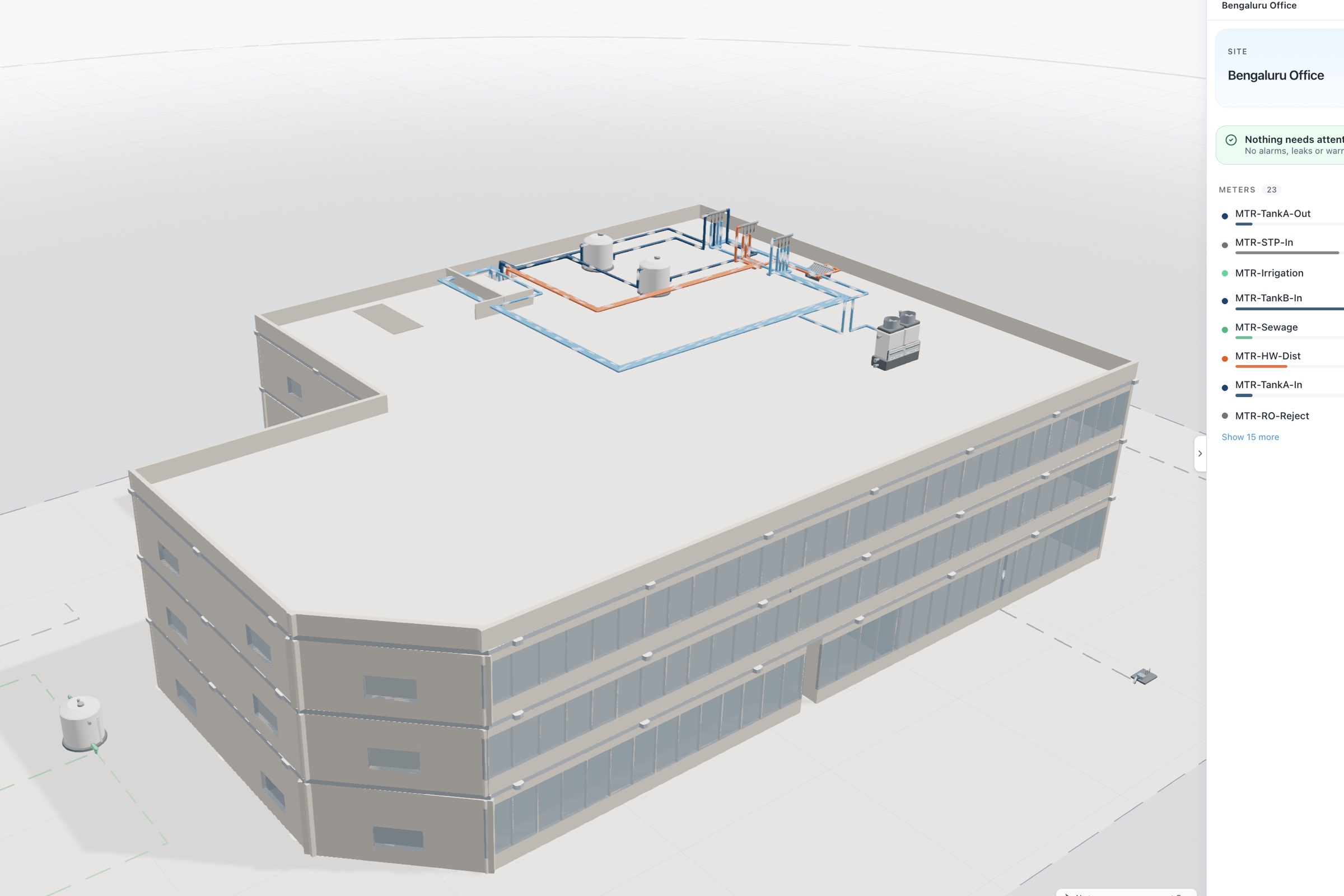
Aqueduct brings every building into one estate model in aQ Core, with a site map and per-building status. aQ EnergySmart and aQ WaterGuard baseline each building against weather, from utility bills on day one, and Billing Management validates invoices against metered use and separates usage changes from rate changes. Faults are diagnosed in plain language and routed to the CMMS.
Smart Controls acts through LoRaWAN relays or Modbus and BACnet field devices, where control is enabled, with owner approval. Lockouts protect equipment and the command history records every command and whether it executed, which is what auditors ask for. Each sensor's health tab shows connection rate and battery level, so the team knows the data can be trusted.